History TL;DR
- 2016: Founded in London by Tim Stokely
- 2018: Fenix International acquires majority stake (Leonid Radvinsky)
- 2020: COVID-19 drives explosive growth — 4.6× more creators in 12 months
- 2021: SFW pivot announced and reversed within 6 days
- 2024: $7.22B gross fan payments, 4.63M creators, 377.5M fan accounts
Timeline of major milestones
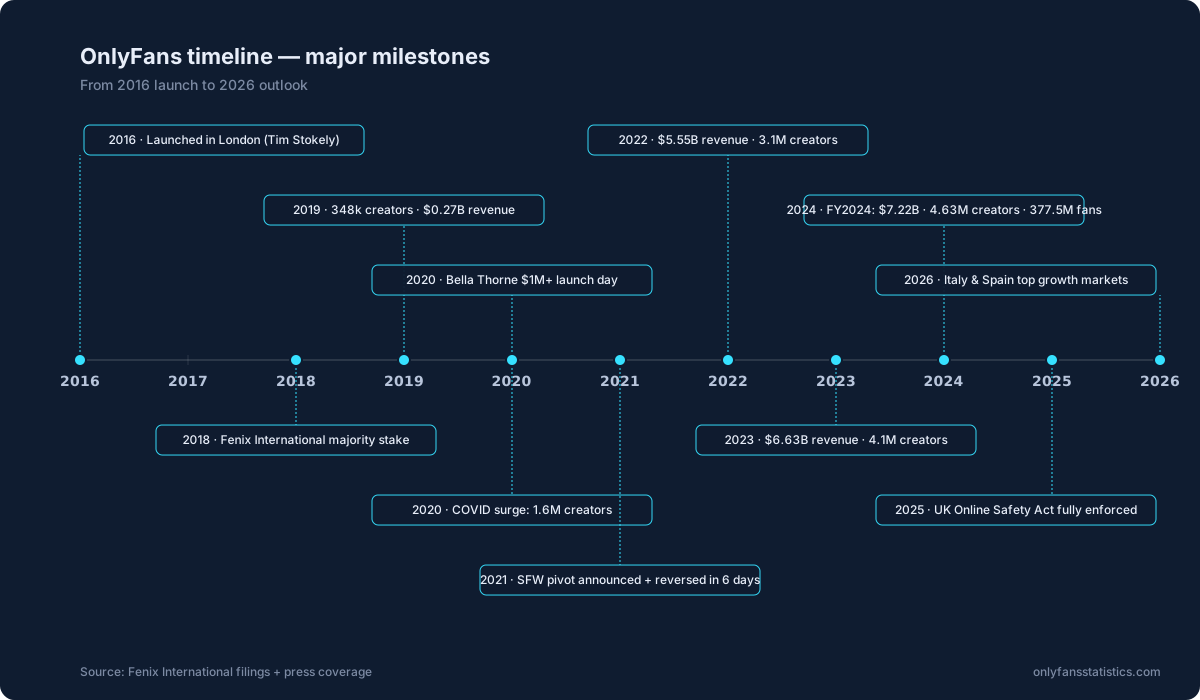
Eleven inflection points across the platform's first decade, from launch to the regulatory era:
2016 — Founding in London
OnlyFans launched in November 2016, founded by British entrepreneur Timothy Stokely with backing from his father Guy Stokely. Tim had previously run several smaller subscription-content platforms targeting niche audiences. The original pitch was deliberately broad: a subscription platform that any creator — fitness coaches, chefs, musicians, or adult-content creators — could use to monetize a fan base without relying on ad revenue or platform-controlled distribution.
The first eighteen months were quiet. Creator counts stayed below ~50,000, and the platform was barely visible in mainstream tech press. Adult content was permitted from day one, which eventually became the platform's defining (and revenue-driving) characteristic.
2018 — Fenix International majority stake
In 2018, Fenix International Ltd — a UK-registered holding company controlled by Ukrainian-American businessman Leonid Radvinsky — acquired a 75% majority stake in OnlyFans. Tim Stokely retained a minority interest and continued as CEO until 2021.
The Fenix acquisition is what makes OnlyFans's revenue auditable today: as a UK company, Fenix files annual accounts with Companies House, which is why we have hard numbers for FY2024 ($7.22B revenue) rather than industry estimates.
2018-2019 — Pre-pandemic growth
Creator counts grew steadily through 2018-2019, reaching approximately 348,000 creators by year-end 2019. Gross fan payments hit $0.27 billion in 2019 — meaningful for a startup but still niche compared to mainstream creator platforms like Patreon.
The platform's growth recipe was already clear: 80/20 creator split (favorable vs Patreon's tiered model), mandatory ID verification (which made it more defensible against legal challenges), and permissive content policy (which built supply on the adult-creator side).
2020 — The COVID explosion
The COVID-19 pandemic transformed OnlyFans. Lockdowns hit just as the global creator economy was beginning to mature, and three forces converged: (1) creators across multiple categories lost their live/in-person revenue and looked for digital alternatives, (2) consumers had more time and disposable income for digital subscriptions, and (3) mainstream press began covering OnlyFans as a creator-economy story rather than (only) an adult-content one.
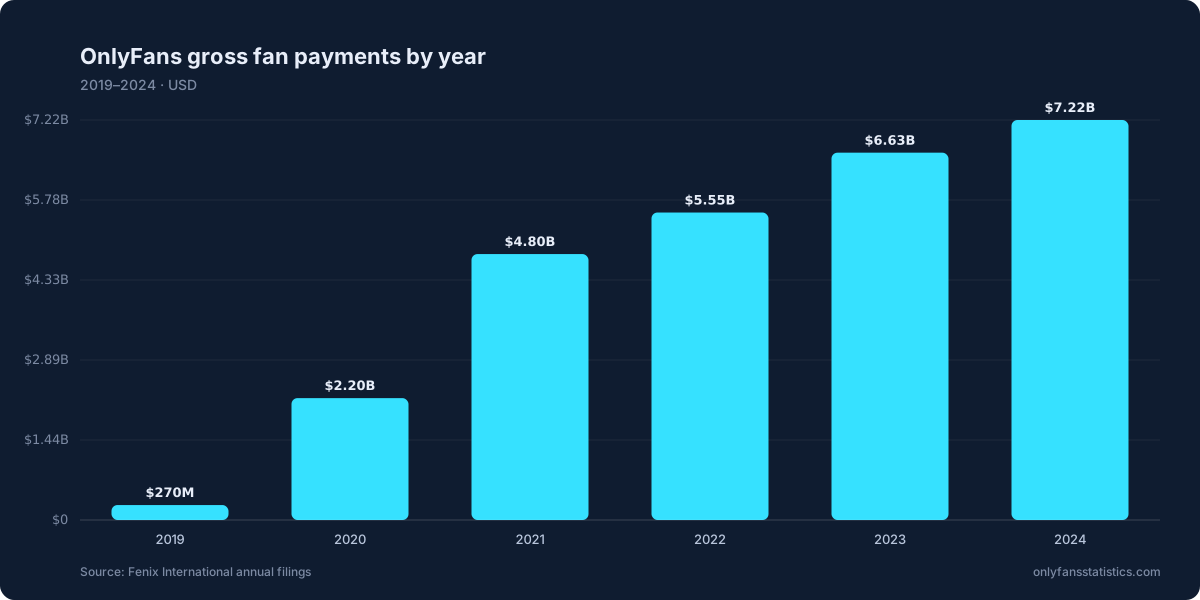
Creator counts went from 348k at end-2019 to 1.6M by end-2020 — a 4.6× jump in twelve months. Gross fan payments went from $0.27B to $2.20B (+715%). It was the steepest single-year growth in the platform's history, and arguably the steepest single-year growth of any major creator platform on record.
Gross revenue trajectory through the COVID years
August 2020 — The Bella Thorne controversy
In August 2020, actress Bella Thorne joined OnlyFans and reportedly earned $1 million in 24 hours and $2 million in the first week. The launch was the platform's first global mainstream-press moment.
But Thorne's launch also caused short-lived backlash: she allegedly charged subscribers $200 for what some characterized as misleading PPV content, prompting refund disputes that spilled into press coverage. OnlyFans subsequently introduced subscription and PPV price caps that remain in force today (subscriptions max $49.99/mo, PPV $50 per item, tips $200).
August 2021 — The SFW pivot reversal
On 19 August 2021, OnlyFans announced that as of 1 October 2021, the platform would prohibit "sexually explicit" content. The stated reason was pressure from payment processors (Visa, Mastercard, and several banks) over reputational risk.
The backlash was immediate and unprecedented. Creators threatened mass exit; major competitors (Fansly, JustFor.Fans) prepared onboarding flows for OnlyFans creators; press coverage was uniformly negative. Six days later, on 25 August 2021, OnlyFans reversed the announcement, citing "assurances from banking partners."
The reversal cost no creator base materially, and revealed something important: by 2021, OnlyFans's payment-processing leverage had grown enough that the platform could push back on processor demands rather than capitulate.
Late 2021 — Tim Stokely steps down
In December 2021, Tim Stokely stepped down as CEO and was replaced by Ami Gan, who had previously been the company's chief marketing officer. Stokely retained his minority equity stake. The leadership transition coincided with a deliberate strategy shift: away from explicit growth-at-all-costs framing and toward a more conventional creator-economy narrative emphasizing professionalism, ID verification, and creator support infrastructure.
2022-2024 — The mainstream wave
Through 2022-2024, OnlyFans's growth slowed in percentage terms (revenue went up 16%, 19%, 9% respectively) but accelerated in absolute terms — adding roughly $1.5B in gross payments per year. The bigger story of these years is profit margin compression: revenue continued to grow but profit growth slowed, signaling rising compliance and processing costs.
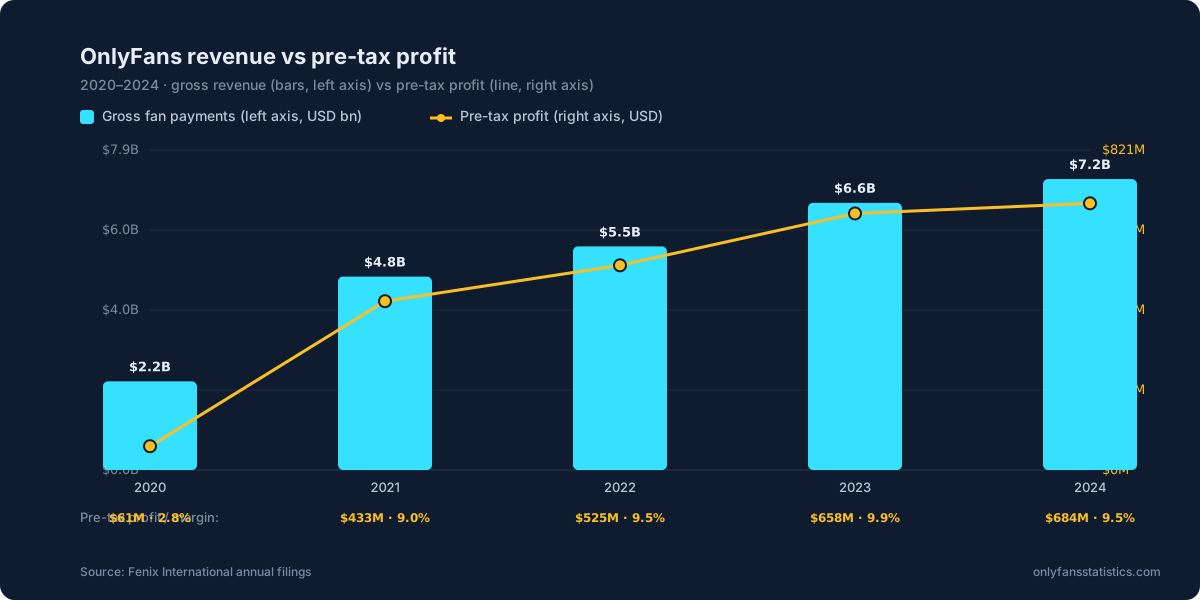


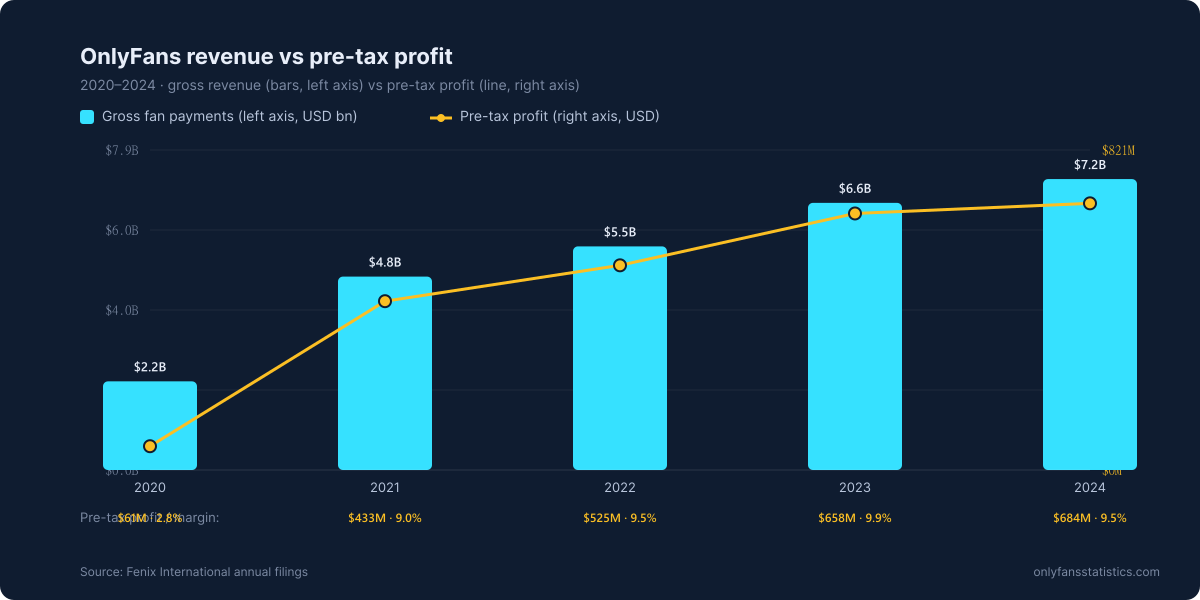
The pre-tax margin trajectory tells the story: 2.8% in 2020 (still scaling) → 9.0% in 2021 → 9.5% in 2022 → 9.9% in 2023 → 9.5% in 2024. The 2024 dip is small but meaningful — it's the first year revenue grew faster than profit, which is what regulatory cost-pressure looks like in financial statements.
2025-2026 — The regulatory era
From mid-2024 through 2026, the regulatory landscape became the platform's biggest non-revenue concern. Three tracks matter most:
- UK Online Safety Act (full enforcement 2025) — age-verification and content-moderation transparency requirements that had been signaling for two years.
- EU Digital Services Act + AVMSD — country-of-origin enforcement, transparency reporting, complaint mechanisms.
- US state-level age-verification laws in Texas, Utah, Louisiana, Mississippi, and others. OnlyFans has elected to comply rather than geo-block (some competitors made the opposite choice).
Cumulatively, these add real cost — and explain why FY2024 profit growth (4%) lagged revenue growth (9%). The regulatory burden is the most likely reason FY2025 (filing expected late 2026) will continue that compression.
Key inflection points — summary
| Date | Event | Why it mattered |
|---|---|---|
| Nov 2016 | Platform launch | Established creator-friendly 80/20 split + adult-content acceptance |
| 2018 | Fenix acquisition | UK incorporation = audited revenue data is now public |
| Mar 2020 | COVID lockdowns | Triggered 4.6× creator growth in 12 months |
| Aug 2020 | Bella Thorne launch | First global mainstream-press moment |
| Aug 2021 | SFW pivot reversal | Demonstrated platform now had payment-processor leverage |
| Dec 2021 | Stokely → Gan handover | Strategy shift toward professionalization narrative |
| 2023 | Crossed $5B annual | Established as top-3 creator platform globally by revenue |
| 2024 | FY2024 audited filing | Confirmed $7.22B revenue, 4.63M creators, 377.5M fans |
| 2025 | UK OSA enforcement | Platform now subject to active regulatory oversight |
Sources
- [FENIX-2024] Fenix International Ltd — UK Companies House filings 2017–2024.
- [REUTERS-2025] Reuters, Bloomberg — corporate-history coverage.
- [FORBES-2024] Forbes — Bella Thorne launch coverage 2020.
- [OFCOM-2025] UK Ofcom — OSA enforcement timeline.
- [VARIETY-2024] Variety — coverage of August 2021 SFW pivot reversal.